
This experiment helps you understand how a capacitor stores and releases electrical energy. Capacitors are important components used in power supplies, filters, timing circuits and many electronic devices.
By charging a capacitor from a battery and then allowing it to discharge through an LED, you can observe how electrical energy is temporarily stored and then released.
Understand how a capacitor charges when connected to a power source and how it discharges when the stored energy is released through a circuit.
The capacitor is connected to the battery through a resistor so it slowly charges. When the battery is disconnected and the circuit is completed through the LED, the capacitor releases its stored energy and briefly lights the LED.
The resistor helps control the charging current and protects the LED.
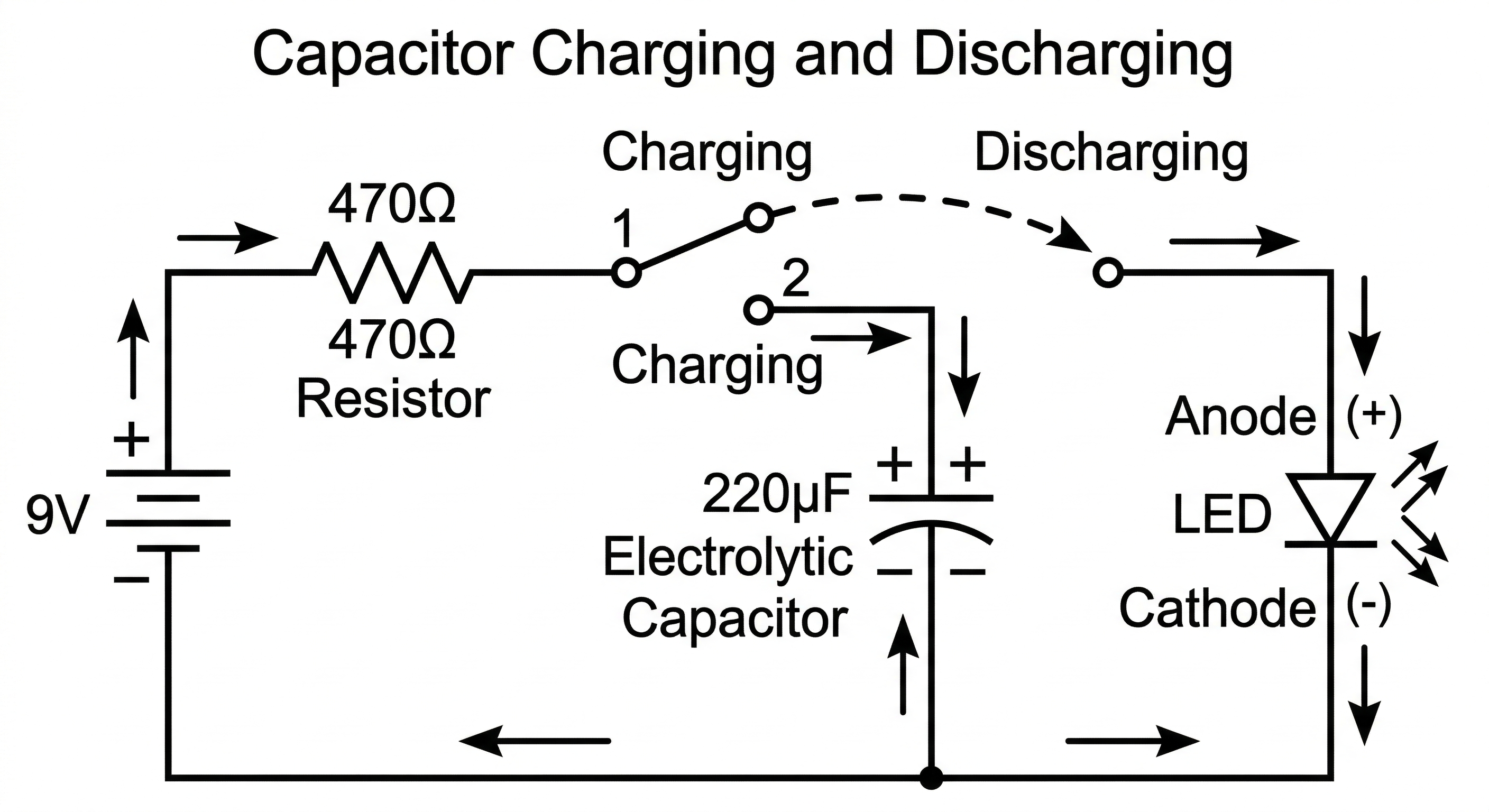
Circuit Diagram showing a Capacitor Charging and Discharging.
The following layout shows how the circuit can be built on a breadboard.
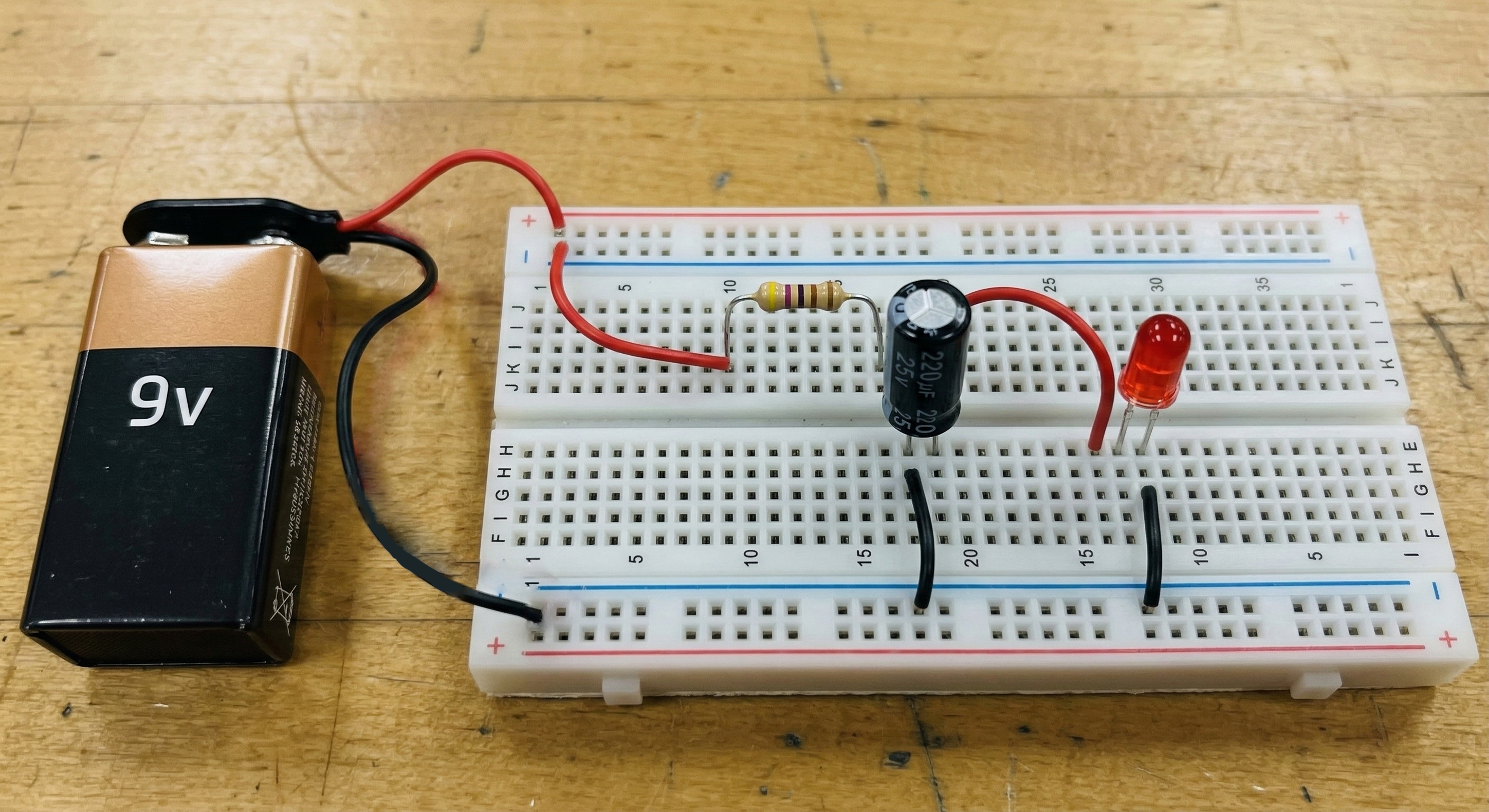
Practical breadboard wiring for the Capacitor Charging and Discharging experiment.
When the capacitor discharges, the LED will briefly light and then slowly fade. This happens because the capacitor releases its stored energy through the LED until it becomes empty.
If the capacitor has a larger capacitance value, the LED may stay lit for a slightly longer time.
A capacitor stores energy in an electric field between its plates when connected to a voltage source. As the capacitor charges, voltage across it gradually increases.
When the power source is removed and the circuit is closed through another path, the stored energy flows out of the capacitor. This flow of current through the LED produces light until the stored charge is depleted.
Electrolytic capacitors have polarity. Always connect the positive and negative terminals correctly to avoid damaging the capacitor.