
This experiment shows how light can control an electronic circuit. By using a Light Dependent Resistor (LDR), the circuit reacts to changes in light levels and turns an LED on or off.
Light sensors are widely used in automatic street lights, display brightness control, and many smart devices.
Understand how a light sensor works and how changes in light intensity can control an electronic circuit.
In this circuit, the LDR senses light intensity and controls the base of the transistor. When the light level changes, the resistance of the LDR changes, which affects the transistor and controls whether the LED turns on or off.
Typically, the LED turns on when the light level drops and turns off when the light increases.
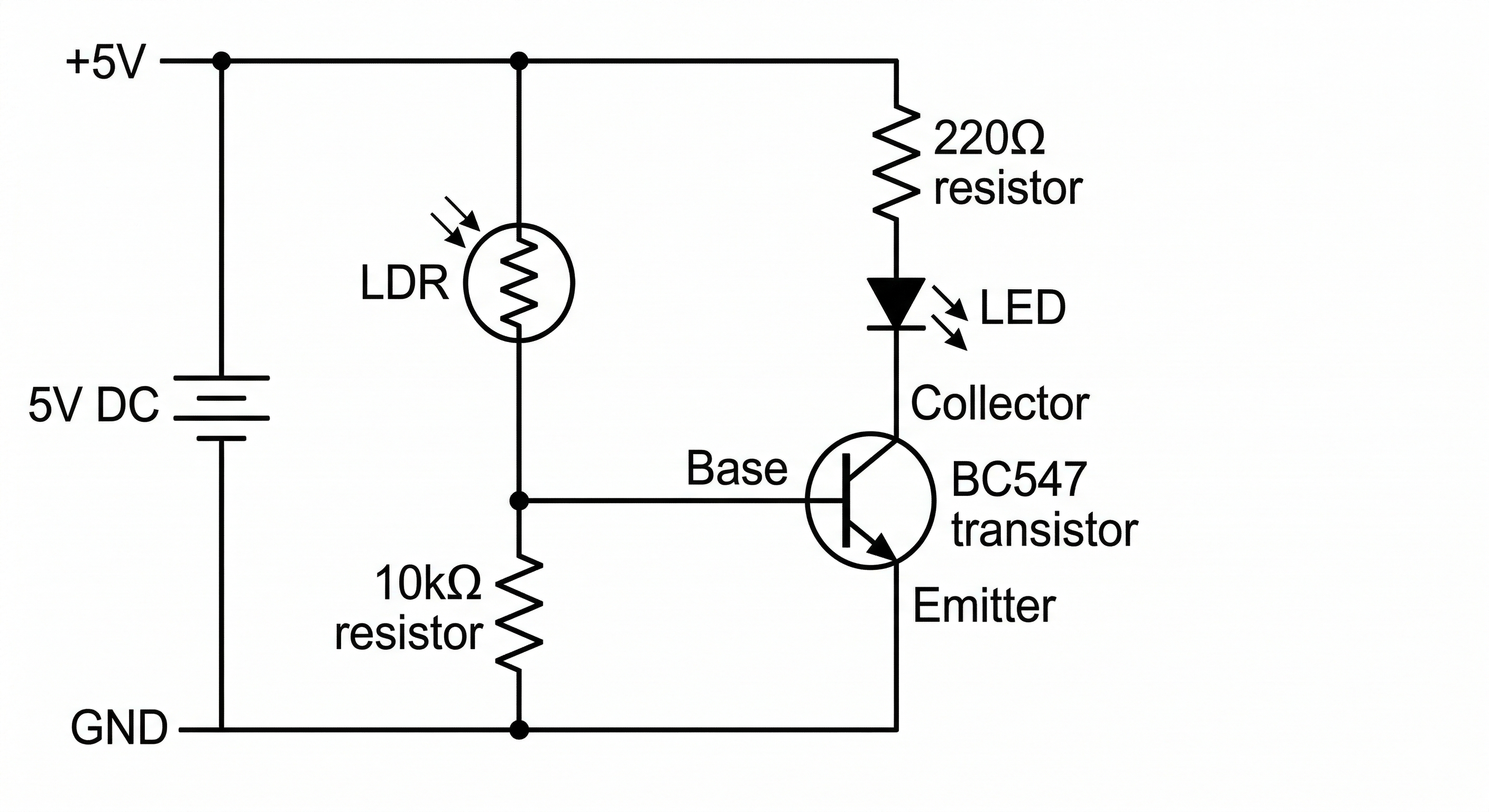
Circuit Diagram showing a Simple Light Sensor Circuit.
When you cover the LDR and reduce the light falling on it, its resistance increases. This change in resistance alters the voltage at the transistor base and allows current to flow through the transistor.
As a result, the LED turns on when the environment becomes darker.
An LDR changes its resistance depending on light intensity. In bright light, the resistance of the LDR is low. In darkness, its resistance becomes high.
This resistance change alters the voltage in the circuit, which controls the transistor. The transistor then acts as a switch that turns the LED on or off.
Use only low-voltage batteries for this experiment. Do not connect the circuit directly to mains electricity.