
This experiment introduces one of the most important components in electronics: the transistor. A transistor can control a large current using a very small input signal.
In this experiment, a transistor will be used as a switch to control an LED. A small current applied to the base of the transistor allows current to flow through the collector–emitter path, turning the LED on.
Understand how a transistor can act as an electronic switch and control current in a circuit.
The LED and resistor are connected in series with the collector of the transistor. The emitter is connected to ground.
A resistor connects the base of the transistor to the control input. When a small current flows into the base, the transistor allows current to flow between collector and emitter.
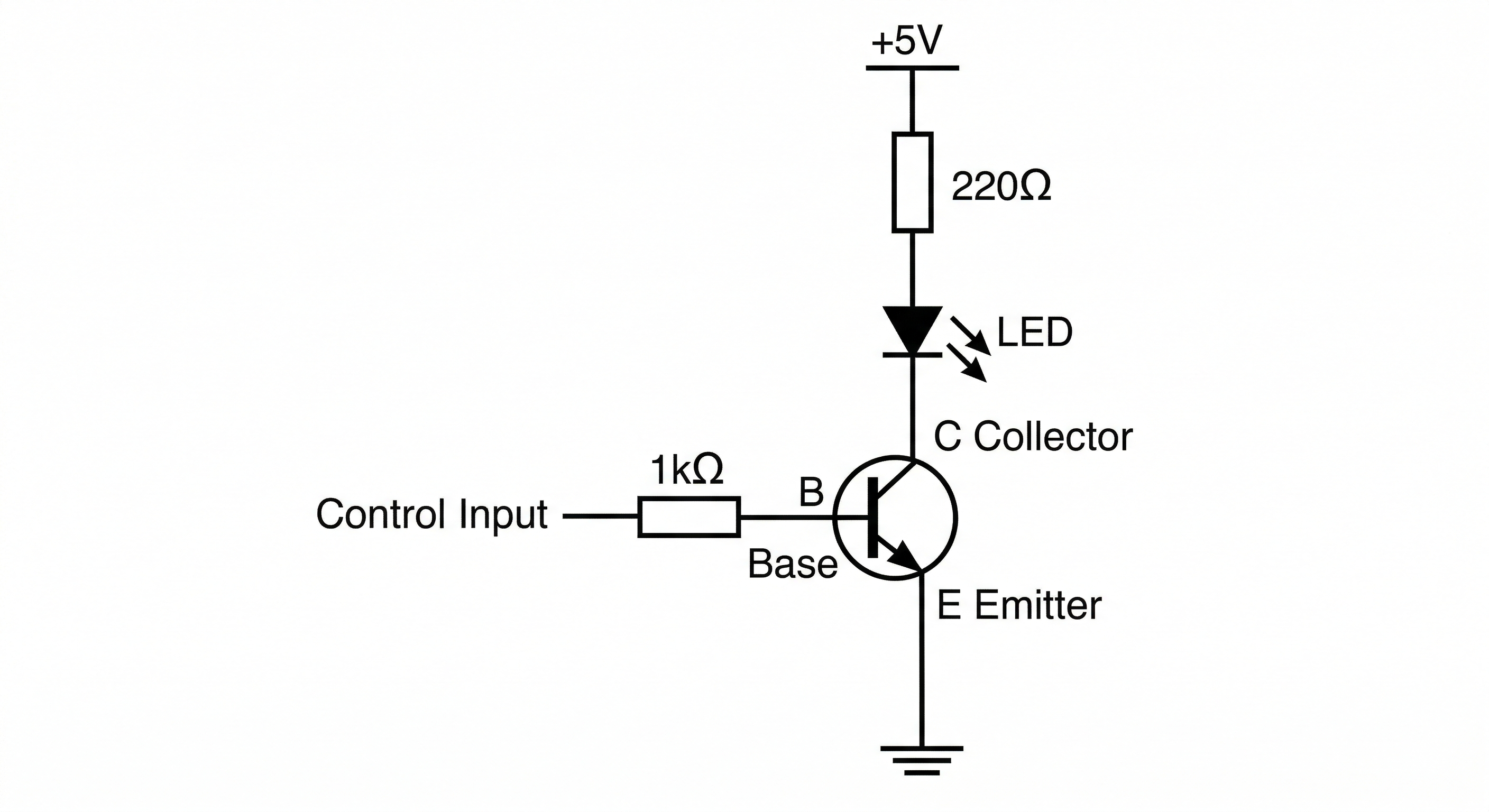
The above diagram shows how the transistor is connected in the circuit.
When the base of the transistor receives a small current, the transistor allows a larger current to flow from collector to emitter.
This allows the LED to turn on. When the base current is removed, the transistor stops conducting and the LED turns off.
A transistor has three terminals: base, collector and emitter.
The base controls whether current can flow between the collector and emitter. A very small base current can control a much larger current through the transistor.
This is why transistors are widely used as electronic switches in circuits, computers and control systems.
Use only low voltage batteries when performing this experiment. Do not connect transistors directly to high voltage power sources.