
This experiment helps you understand an important property of a diode: current can flow through it in only one direction.
By connecting a diode to a battery and LED, you will observe how the diode allows current to pass in one direction and blocks it in the opposite direction.
Understand how a diode controls the direction of current flow in an electronic circuit.
Connect the diode in series with the LED and resistor. The diode should face the direction in which current is intended to flow.
The side of the diode with the stripe is the cathode. Current flows from the anode toward the cathode.
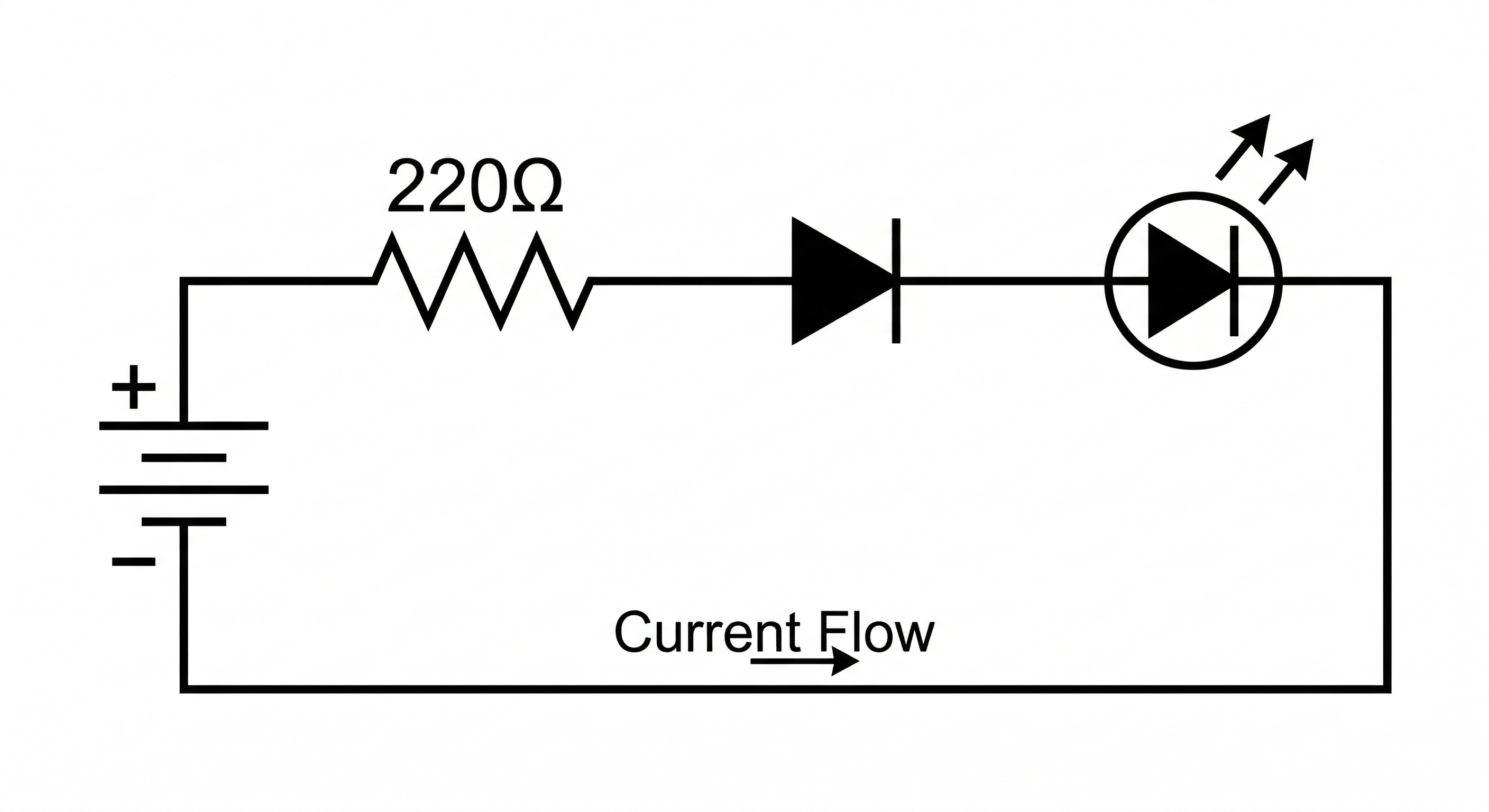
Above diagram is for Understanding Diode Direction.
When the diode is connected in the correct direction, the LED will light because current can pass through the diode.
If you reverse the diode direction, the LED will not light because the diode blocks current in that direction.
A diode is a semiconductor device designed to allow current to flow in one direction only. Internally it contains a junction between two types of semiconductor material.
When the diode is forward biased, current flows easily through the device. When it is reverse biased, the junction prevents current from passing through the circuit.
This property makes diodes useful in power supplies, signal circuits and protection circuits.
Always use a resistor with an LED to limit current. Do not connect LEDs or diodes directly to high voltage power sources.